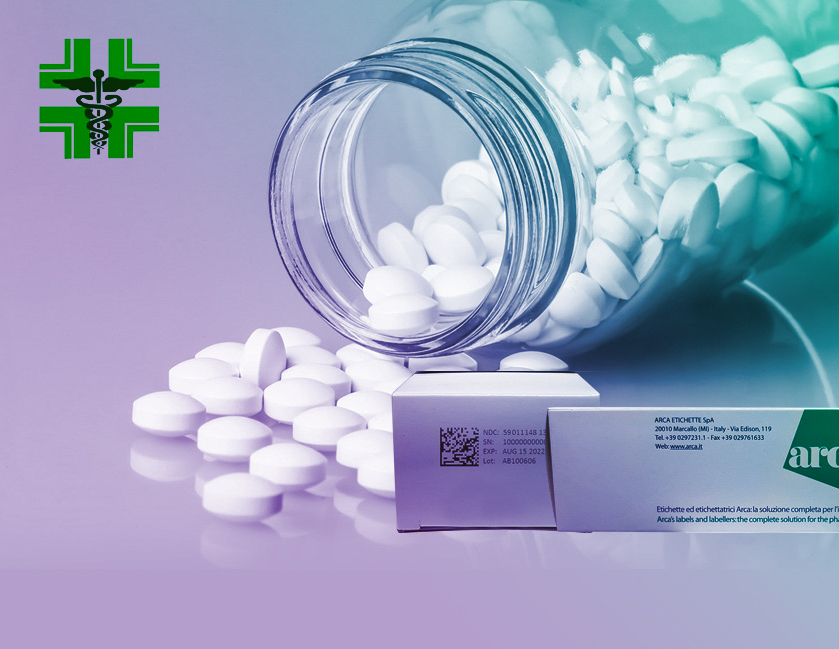

Counterfeit pharmaceutical products pose enormous health risks to consumers and significant economic losses to the pharmaceutical industry. This is why automatic labeling systems for pharmaceutical serialization and tamper-proofing are necessary.
Automatic labeling systems for drug serialization
Absolute product safety is a requirement for the end consumer and requires complete control over the flow of products, from manufacturing to distribution. It is in this context that many countries have decided to adopt regulations aimed at introducing security features for the packaging of medicinal products for human use. This is a significant change that will guarantee the authenticity of drugs and safety for patients as well as for the pharmaceutical industry , and will strengthen the security of the drug supply chain, from manufacturers to pharmacies and hospitals, all the way to patients.
Pharmaceutical labeling system
One of the components of anti-counterfeiting is certainly the individual package identification process, which falls under the concept of serialization. The pharmaceutical labeling system ensures that every package subject to the obligation to integrate safety features will be coded with a 2D code (GS1 Data Matrix) containing a unique identifier. The data must also be printed in human-readable format and, if possible, adjacent to the two-dimensional barcode containing the unique identifier.
In addition to the unique identifier, the integrity of the tamper-evident system (see point 5) ensures that the packaging has not been opened or altered since release from the manufacturing facilities, thus ensuring the integrity of the drug contained within.
Currently, serialization requirements are limited to marking a unique code on each individual product sold. However, by 2023, each product will need to be traceable throughout the entire logistics chain: individual packaging, box/pallet, and final distribution point. This level of serialization is called aggregation.
PHARMACEUTICAL STAMP: CODING, SEALING AND SOFTWARE TRACEABILITY
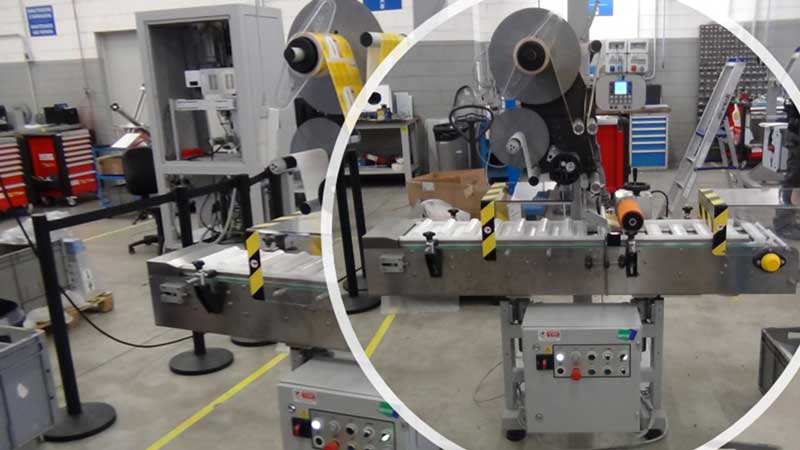
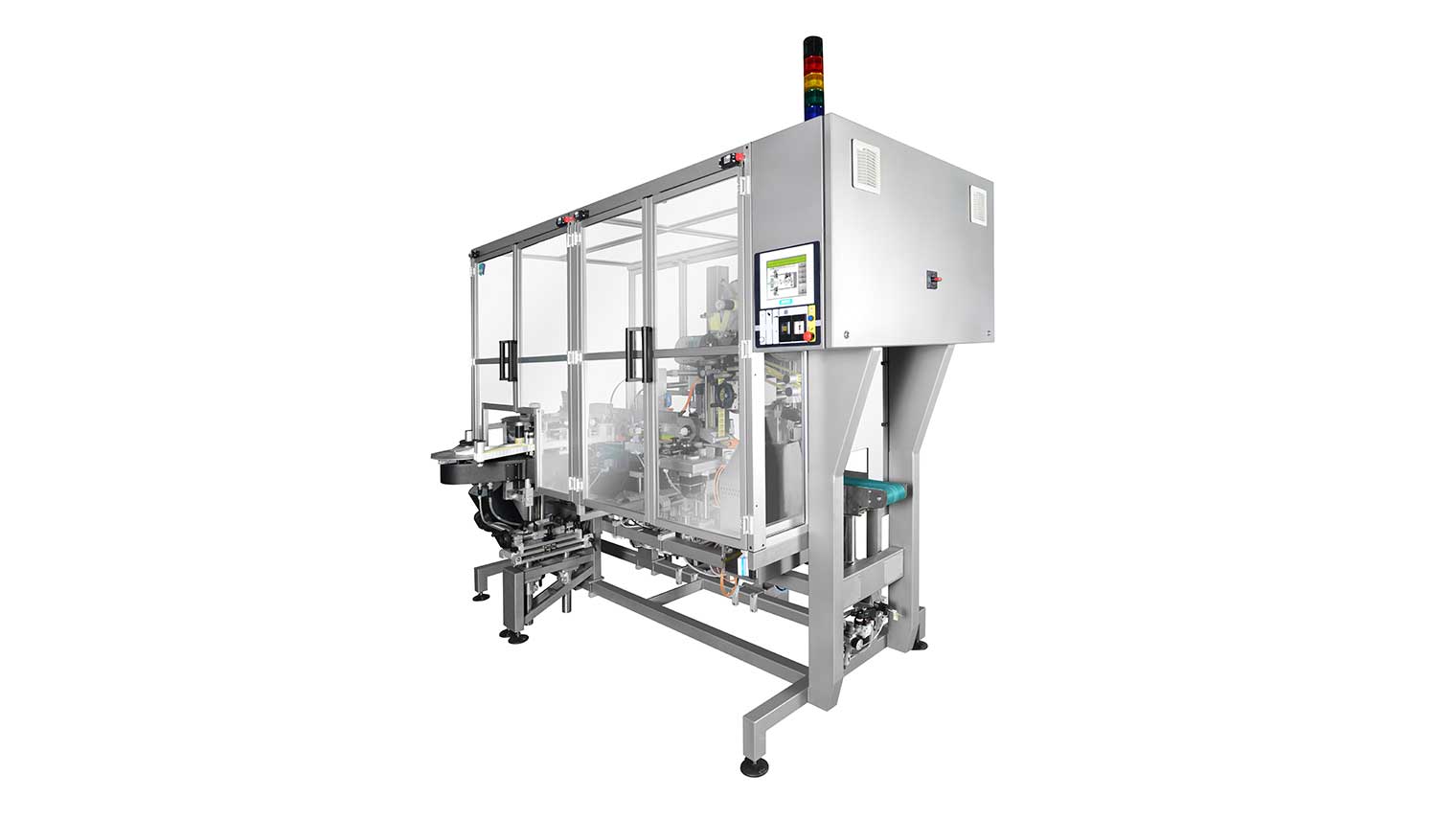
Arca systems guarantee safety and high-quality labeling. We have designed and engineered the best pharmaceutical serialization machinery to ensure complete results.
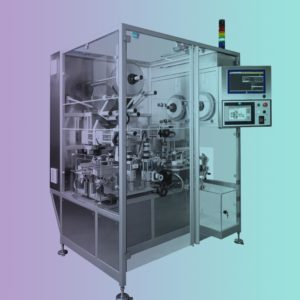
Pharmaseal 5.0
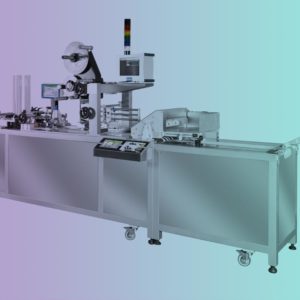
cardboard
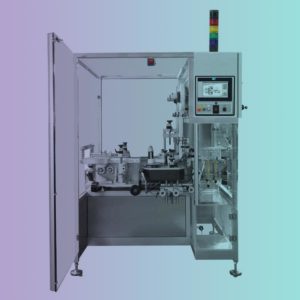
Tamper-evident seal
International regulations
XNUMX-XNUMX business days
In 2011, the European Union issued a specification relating to Falsified Medicines (DIRECTIVE 2011/62/EU) which indicated the key points of anti-counterfeiting which can be simplified into concepts relating to “Safety Features” such as: Authenticity, Identification, Anti-tampering.
The rules set out in Delegated Acts (EU) 2016-161 apply from 9 February 2019 to all European Union Member States, with the sole exception of Belgium, Greece, and Italy, which, at the time of the entry into force of Directive 2011/62/EU, already had systems in place to verify the authenticity of medicinal products and identify individual packages (pharmaceutical label, see point 6). For these countries, the provisions set out in the Delegated Acts must be applied from 9 February 2025 at the latest.
The continued growth of exports in the Italian pharmaceutical industry demonstrates the sector's ability to compete in foreign markets. To continue growing, it will therefore be necessary to rapidly adapt production facilities to Directive 2011/62/EU.
Rest of the world
Serialization is already required by regulations in countries as diverse as Argentina, Turkey (considered a pioneer in this regard, having mandated monitoring of the entire supply chain as early as 2010), South Korea, and China. Pharmaceutical serialization is also already a reality in Saudi Arabia and Iran, where Data Matrix has been mandatory since March 2017 and the aggregation process may soon be integrated.
Serialization has been mandatory in the US since November 2017. However, the FDA has specified that "no action will be taken against manufacturers who do not comply with the regulation until November 2018." Aggregation will be required starting in 2019 and mandatory by 2023.
The closest deadlines
The European Falsified Medicines Directive (FMD) makes serialization and Tamper Evident sealing mandatory for all medicines entering the European single market starting in February 2019. For this reason, some non-EU countries such as Switzerland, Norway, and Iceland have also decided to comply with the FMD.
Other upcoming deadlines for pharmaceutical serialization implementation include: Egypt (June 2018), Russia (December 2019), Pakistan (December 2019), Jordan (January 2020), and Brazil (December 2021).
Other members of the Gulf Cooperation Council are expected to follow Saudi Arabia's example in pharmaceutical serialization.
The same goes for Ukraine, which will adapt to existing Russian and EU regulations.
Generally speaking, every pharmaceutical manufacturer will be required to comply with the regulations of the markets in which they intend to sell their products. Therefore, pharmaceutical companies exporting their products abroad are subject to these regulations even if serialization is not yet regulated by local law.
The unique product identifier
The regulation defines the characteristics of the UNIQUE IDENTIFIER that will be marked on all packaging.
The identifier will consist of 4-5 pieces of information, presented in a readable, two-dimensional format, depending on the destination country and its specific regulations. It will be communicated to a multi-level archive structure to allow for verification.
• Code that allows you to identify the common name, pharmaceutical form, dosage, size and type of packaging of the medicine;
• A numeric or alphanumeric sequence of no more than 20 characters, generated by a randomization algorithm
• A national reimbursement number or another national number identifying the medicinal product, if required by the Member State in which the product is intended to be placed on the market;
• The batch number ;
• The expiration date ;
How can it be achieved?
To create the unique code marking directly on thepencil case pharmaceutical, there are two main techniques capable of ensuring excellent marking quality while maintaining high productivity:
– Inkjet markers
– Laser markers
Currently, the most commonly used solution by pharmaceutical companies is inkjet marking. However, more and more companies are choosing laser marking, which offers a series of very interesting competitive advantages:
- UNMATCHED PRODUCTIVITY thanks to the ability to work continuously, without any stops for the supply of consumables.
- INDELIBILITY Laser marking is forever.
- ECONOMIC OPERATION The laser does not use any consumables (e.g. no liquid ink).
- HIGH GRAPHIC QUALITY always consistent over time.
- MINIMUM MAINTENANCE thanks to the absence of moving parts and components subject to wear.
- ECOLOGY The laser does not produce waste to dispose of.
- ABSOLUTE CLEANLINESS The light does not make a mess.
- VERY HIGH LIFE EXPECTANCY up to 100.000 hours on non-stop production lines.
What is traceability software?
For manufacturing companies operating in the pharmaceutical sector, it has become mandatory to have IT tools that rigorously support the entire management cycle, as well as the manufacturing process.
Industry characteristics and quality standards have pushed pharmaceutical companies to extend IT procedures for traceability throughout the entire production process, from raw material purchasing to production, from quality controls to distribution to external warehouses and customers.
To manage this complex IT process, the pharmaceutical industry relies on companies specialized in the development of TRACK & TRACE software.
As reported by the international standards ANSI ISA-95 (standard of the International Society of Automation for the development of an automated interface between business systems and control systems), the following technological levels can be distinguished in serialization systems.
Level 0: the production lines of pharmaceutical companies (according to ISA-95 “ It defines the actual physical processes ”).
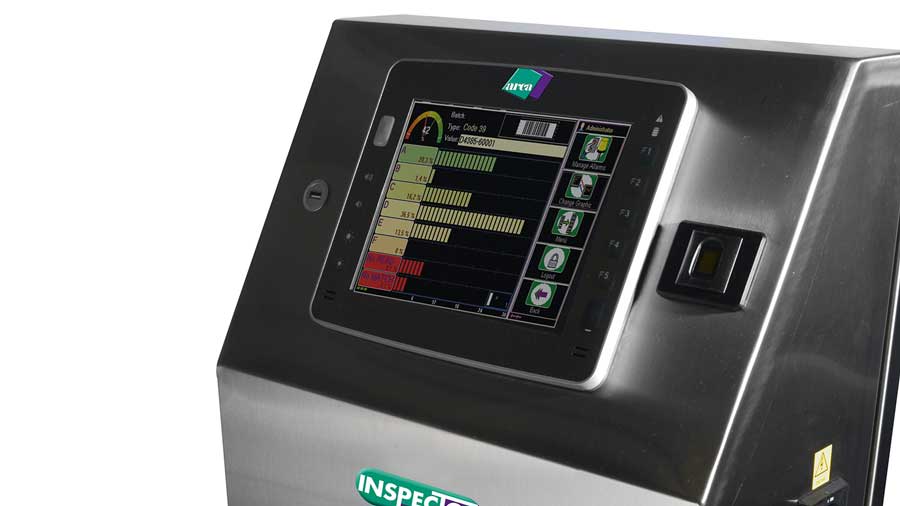
Level 1: Line equipment for marking, labelling and inspection such as labellers, inkjet or laser markers, vision systems and code verifiers, desktop printers (according to ISA-95 “ It defines the activities involved in sensing and manipulating the physical processes ”).
Arca is a manufacturer of level 1 devices.
Level 2: the management and control software for serialization on each packaging line (according to ISA-95 “ It defines the activities of monitoring and controlling the physical processes ”).
It enables the reception of serial numbers, their transmission to the marker and video camera, inspection and data acquisition, aggregation into multiple packages and "rework", the start and end of each production batch, and safety management (CFR 21 part 11). Once the unique code marking and inspection process is complete, Level 2 communicates the serialization and aggregation data to the higher levels.
Level 3: the software for the overall management of serialization at each production site (according to ISA-95 “ It defines the activities of the work flow to produce the desired end-products ”).
At Level 3, serial numbers for each product unit are automatically generated or received externally. This centralized platform (software installed on a central server connected to all packaging lines) avoids data redundancy, facilitates backups, and enables secure management of serialization data while ensuring operational autonomy for the production lines.
Level 4: the ERP interface software of pharmaceutical companies towards other players in the supply chain and national agencies (according to ISA-95 “ It defines the business related activities needed to manage a manufacturing organization ”).
International regulations require each pharmaceutical company to make all serialized data available to authorized manufacturers (Manufacturing Authorization Holders, Contract Manufacturing Organizations), all supply chain partners (such as pharmacies and hospitals), customers, and authorities.
The ANSI standard explicitly states that, especially in the area of security, additional system levels may be identified. In fact, the following additional level is commonly identified within serialization:
Level 5: centralized data bases on a national or supranational scale, as in the case of the European Union (according to ISA-95 “ There are other non-manufacturing business-related activities that may be in levels 1 through levels 4 or higher levels, but these are not defined in this standard; for example, security activities ”).
How to ensure the integrity of the packaging
Anti-counterfeiting regulations do not specify a specific method for ensuring packaging integrity. Technically available systems include: sealing by applying glue to the package flaps, applying "tamper-evident" security labels, wrapping the entire package in a sealed film, and using specially designed folding cartons.
The most widely used solution in the pharmaceutical industry is undoubtedly the application of Tamper Evident self-adhesive labels . The two most common techniques for ET are:
- Wipe Out: Tamper-proof labels/seals; products made of destructible materials that break when lifted from their packaging or the surface to which they are applied, preventing them from being replaced.
- Void Labels: Tamper-proof labels/seals; when lifted, they leave a colored print with your custom writing on the package; repositioning leaves visible writing.
These two types of labels/seals may contain additional security elements:
- latent microtexts
- Wood/QFX/Affirm/UV mask inks
- photochromic and thermochromic inks
- pen reactive inks
- Guilloche printing and watermarked paper
The pharmaceutical stamp
The pharmaceutical label is a label made of three-layer adhesive paper containing all the information necessary to identify a particular medicine and each of its individual packages.
The scenario in Italy
If a prescription for a medicine is covered by the National Health Service (NHS), the pharmacist removes the top layer of the label, but a portion remains on the packaging to allow identification. Initially, the pharmaceutical label included the AIC barcode (an identification code for drugs intended for use in humans, assigned to the pharmaceutical manufacturer along with the marketing authorization) and a barcode containing a sequential number established by the State Printing Office and Zecca during the printing process. Starting January 1, 2016, the State Printing Office and Zecca has been producing a new type of pharmaceutical label that includes a third barcode (the 2D Data Matrix code), which summarizes the information contained in the first two codes. These barcodes can be easily read and acquired by scanning with a dedicated optical reader. The Ministry of Health decree regulating the use of the pharmaceutical stamp also establishes the procedures for canceling it in cases where the medicine packages are destined for hospitals, used as free samples, or for export or disposal.
A double function: traceability and information gathering
The pharmaceutical label, scanned as the drug package passes through the country (from the manufacturer to the patient), is communicated to a dedicated central database at each step, allowing its exact location to be identified at any time. In addition to ensuring the authenticity of the drugs, this mechanism allows the Ministry of Health to verify the type and number of drugs prescribed locally, obtaining other useful information such as the consumption of a specific medication. The collected information can then be used to develop a snapshot of the health status of the entire nation, obtaining valuable information such as the presence of particular diseases, the geographic areas in which they are most prevalent, the age and gender of the affected patients, and the type of treatment prescribed.
Read also the article: Labeling and marking solutions for OEMs